
I am writing this from the Abbey of Fleury in France, one of the oldest abbeys of the Benedictine Order. Founded around 630, this abbey has played a crucial role in the spiritual and cultural life of medieval Western Europe. It is known for housing the remains of Saint Benedict. I am here with the intent of silent retreat, among others who are also called inward, and although I would not have chosen a monastery as the backdrop for such enquiry, here I am.
I grew up with Catholicism, attended Church with my family, and went to a Catholic girls’ school, which honestly was painful to my child self. The only resonance I felt at mass was shaking the hands of strangers during the offering of peace and drinking the wine, which made me feel pleasantly tipsy (sadly, no longer on offer in most services these days).
As a teenager with budding feminist shoots, I found the services isolating and unrepresentative of the woman I saw myself growing into. The only feminine image offered was a virgin mother and whispers of a whore, standing beside a male God serving male authority. I turned my back on the Church and sought out Lilith instead, who became a fierce idol for me, a reflection of liberation, power and sexual freedom, though not without her own shadow: feminine resentment and rage among them.
Last year I started a journey of devotion and study with the Sufi tradition, which honestly restored my faith in wisdom streams: the completeness of the teachings, the inclusion of the natural world as holy, the teachings of beauty, devotion and ecstatic praise. In many ways it carried me back toward the Church, as Sufism gave me a framework I could surrender to without feeling I was betraying the wholeness of my humanity.
So returning to the Abbey has been a beautiful experience: to sit in a space where centuries of prayer have been whispered into ancient stone walls. I have been moved by the Benedictine monks, and by how profound it is to give one's life to prayer and to the many rituals of Church life: service, eucharist, daily chanting. I was also grateful, in a way, that I didn't understand the homily, spoken in French, and so was spared some of the more dogmatic Old Testament verses. I don't resonate fully with the institution, but I can now appreciate what was hidden behind my own casting out. I can appreciate the perfections within the imperfections. What I do want to share though is the postcards of beauty, the moments where I was touched by my time here.
Meeting a young woman who does not own a phone and relies on strangers to help her find her way through the world.
It wasn't that long ago that none of us had phones, and we too followed our instinctive, adventurous guidance in the world. I remember walking the streets of Athens at 21 years old without even a guidebook, following some inner compass that led me into the full spectrum of life, not one that I selected or controlled through google reviews. This woman shared that not having a phone opens up a sense of childlike adventure and possibility, unlike the program of probability most of us are slaves to these days, from having access to everything known.
I honestly miss the art of being lost. When you don't know where you are, you have to look up, take note of your surroundings, that tree, that decrepit building. You have to speak to a stranger, which means letting yourself be seen needing something, and trusting them to decide to help. In that small exchange, a thread of trust gets spun between two people who would otherwise have passed each other by, unmet. Being lost invites a slowing down and an acute presence, and through this we come into contact with an unknown world and find our relationship within it.
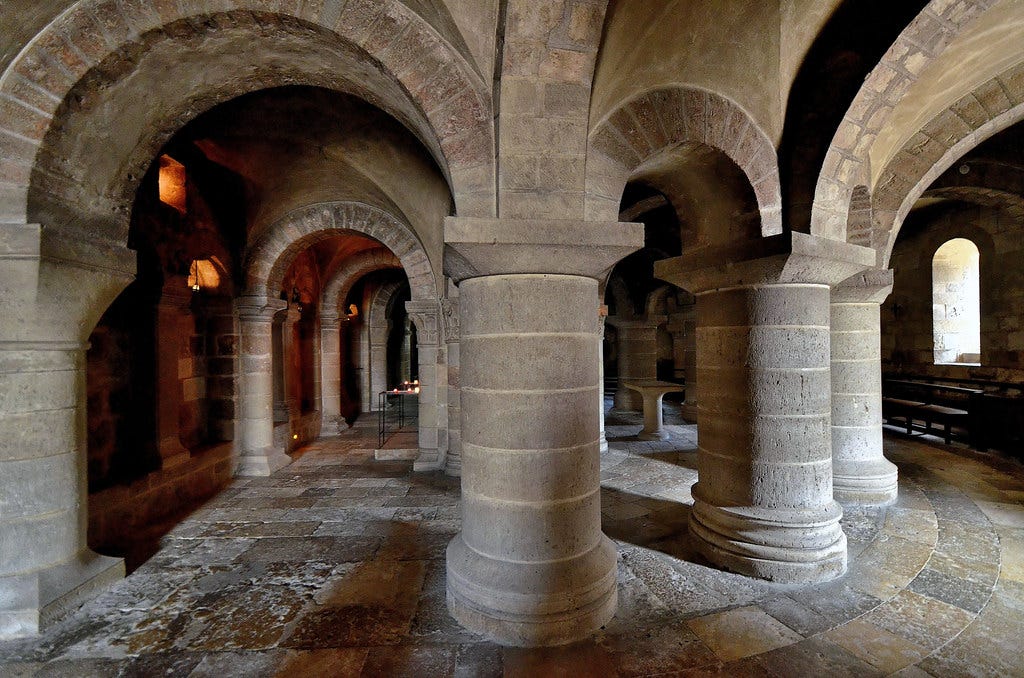
This woman is spending ten days here in prayer, and yesterday I had a beautiful moment in the corner of the crypt, cloaked in darkness, witnessing her in prayer. The beauty and joy that passed over her face, the wonder pouring from her as she gazed into the candles lit around the entombed relics of St Benedict. Something in my heart was so touched by the simple wisdom of her presence and childlike grace.
A pigeon burial ceremony
I had brought some red roses to the monastery as an offering for Lammas, and within minutes of arriving they were part of a funeral for a pigeon. Outside the door of the sleeping quarters was a beautiful pigeon, its wings slightly splayed, patches of multicoloured feathers glistening in the light. Although it was dead, it was beautiful. I bent down to offer it some rose petals, and a man emerged from the building, speaking to me in French and pointing at the bird. As usual I stammered "no français," and in broken English he told me he had witnessed the bird being shot, and had brought it to the monastery. He was crying, sharing how he could not believe someone could kill a bird from the sky. Together we dug a hole in the little garden and filled it with his tears and my rose petals. It felt beautiful to honour this creature and its death, and to share a moment with this man. His grief and distress felt bigger than this one small death, his tears seemed to contain a multitude of unexpressed moments in this life, which opened up a place of compassion within me. There was something holy in simply being there for it.
Witnessing the monks sing to Mary
One evening I was strolling the fields around the monastery, watching the swirling glow of the sunset paint the sky, when I felt the impulse to go into the Abbey. By the time I entered, the prayer service had ended, and as I opened the door, the lights went out. Many people were leaving, but I slipped in and watched the monks walk into a small prayer area dedicated to Mother Mary. There were around twenty monks and five of us who were not. Candles were lit around her statue, the rest of the Abbey sank into darkness, and they began to sing to her. Silent tears rolled down my face as I witnessed the beauty of their devotion, and I felt years of built up armour toward the Church in relationship to the feminine, begin to melt in that moment. One of the monks sprinkled holy water over our heads, and it merged with my own tears.
The Beauty inside the Crypt
I spent many hours in the crypt over these days, sitting in a darkened and hidden corner, and so was privy to many pilgrims coming to light candles to Saint Benedict and pray. He is a saint people often come to for protection against temptation, but also for a gentle death, it is said his own death came while he stood in prayer.
I witnessed the beauty of humans when they come into contact with what they feel to be sacred and holy, when they turn to their maker. The silent and muffled tears, the whispering of prayers, the rosary beads rolling inside palms, the calls for help, the joy and the awe.
It is beautiful.
Bonjour Winter, Tyty est le nom de ma vieille minette de 22 ans. Bard la 1 ère syllabe du nom de ma mère. C’était pour être moins visible lorsque je travaillais dans un milieu professionnel compliqué.
Je suis Isa. Nous nous sommes croisées à l’abbaye.
J’ai lu et été très touchée des deux dernières commentaires postés . L’avant dernier m’a bouleversée et ravivé mon propre parcours bien que très différent dans les formes.J’ai répondu par email, je ne sais pas s’ils ont simplement voyagés. Où ils ont atterris!
Te lire le moment où nous finissions avec Alexandre la retraite , donc le portable à nouveau allumé , et le 1 er email étant le tien à s’afficher, et bien c’était étonnant car tu étais à côté de moi!
Ta présence je l’ai sentie dans ce lieu et c’était discret et lumineux.
C’est étonnant car j’ai, en allant seule ds l’abbaye un matin de pause, vu un pigeon mort à l’entrée, j’ai demandé autour de moi et personne ne répondait spécialement alors je l’ai porté à un endroit que j’avais repéré sous des bosquets et mis des tas de feuilles séchées de branchages , toute désolée: tout être ayant vécu devrait avoir droit à être accompagné. Cet homme a eu de la chance de te croiser.
J’aurais bien vu des moments de rituels dont tu parles sur certains temps lors de la retraite.
Je ne suis pas certaine avoir les moyens de me rendre en Nouvelle Zélande ou en Australie. Mais c’était précieux de te voir autant incarnée dans ce que vous proposez , Alexandre, et toi dans ce que je lis que tu partages.
J’ai aimé comme Alexandre préparait avec beaucoup d’attention à chaque repas ton assiette, jamais machinalement, comme pour la plus précieuse des êtres. C’était beau à voir
Bon un peu plus et vous emportiez mon sac où j’avais tout. 😉💞